




Smartphone Screen Types: The Differences

Complete Guide to Displays:
AMOLED, TFT, IPS, In-Cell, Hard and Soft OLED
In the world of mobile phones, understanding the differences between various types of displays is essential, especially if you work in repairs or purchase phone replacement parts. But what do they actually mean? What are the differences between Hard OLED and Soft OLED and other technologies?
Here is a clear and practical guide to help you navigate the main types of screens used in smartphones.
TFT Display Technology
TFT stands for Thin Film Transistor and is a technology used in LCD (Liquid Crystal Display) panels. It is one of the most common solutions, especially in low-end smartphones or budget models, due to its affordable cost.
The TFT display works via a grid of transistors (one per pixel) that individually control each point on the panel. These transistors regulate light passing through the liquid crystals, thus modulating the colors and images we see on the screen.
✅ Advantages
Low cost: one of the cheapest display technologies, perfect for entry-level devices or budget replacements.
Sharp images: offers good clarity for basic tasks like messaging or browsing.
Widely available: easy to find, even for older models.
Check our top models: Galaxy A15, Galaxy A21s, Oppo A94, Redmi Note 11
❌ Disadvantages
Narrow viewing angles: colors distort when viewing the screen from an angle.
Less accurate color reproduction: colors may appear less vivid compared to more modern technologies like IPS or AMOLED.
Higher energy consumption: TFT is always backlit, consuming more power than OLED or AMOLED displays.
Proximity and fingerprint sensors: may not always work.
IPS Display Technology
IPS stands for In-Plane Switching and is one of the most advanced and widely used LCD (Liquid Crystal Display) technologies, especially in mid-range and high-end devices. It is an evolution of TFT displays, designed to overcome their limitations, particularly in image quality and viewing angles. Unlike traditional TFTs where liquid crystals move perpendicularly, in IPS the crystals move parallel (in-plane) to the panel. This improves light distribution and allows more precise control over colors and brightness.
✅ Advantages
Wide viewing angles: the image stays clear and colors consistent even from side angles.
More accurate and natural colors: IPS provides much better color reproduction than TFT.
Good sunlight visibility: improved backlight management.
Overall higher visual quality: ideal for videos, gaming, or work on smartphones.
❌ Disadvantages
Slightly higher power consumption than AMOLED: backlight is always on.
Higher cost than TFT, but still lower than AMOLED or OLED.
AMOLED Display Technology
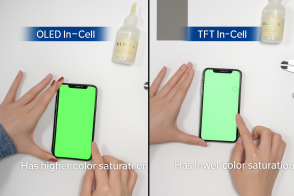
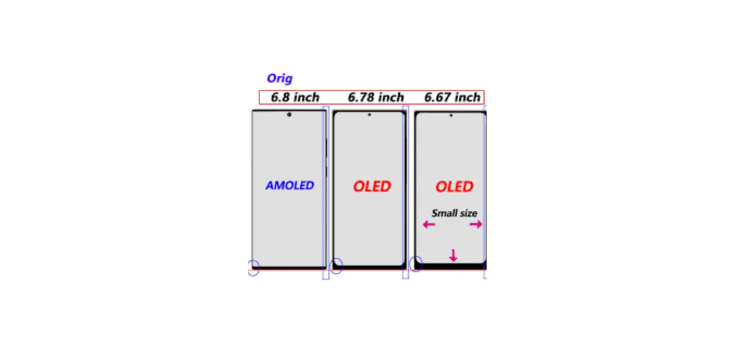
AMOLED stands for Active Matrix Organic Light Emitting Diode. It is a display technology that uses self-emitting organic LEDs with an active matrix. AMOLED is used in premium devices for its superior visual quality, thinness, and energy efficiency. Unlike LCDs (TFT and IPS), AMOLED does not require backlighting: each pixel illuminates independently. This allows deep blacks, high contrast, and vibrant colors.
Each pixel in an AMOLED display contains organic material that emits light when electricity passes through. The Active Matrix controls each pixel’s on/off state precisely and quickly.
✅ Advantages
Perfect blacks: pixels turn off completely, enhancing contrast and saving power.
Vivid, saturated colors: ideal for multimedia, gaming, and photography.
Thin design: lighter and thinner screens, perfect for curved or edge-to-edge designs.
Energy-efficient: consumes less power in dark themes compared to LCDs.
Fast response time: smooth video and animations.
Check this AMOLED Display for Xiaomi Mi 10 / Mi 10 Pro for a high-quality replacement.
❌ Disadvantages
Higher cost: premium technology means more expensive replacements.
Possible burn-in: prolonged static images may leave permanent marks.
Limited lifespan: organic materials degrade over time, especially blue pixels.
In-Cell Display Technology
The In-Cell display is an advanced LCD where the digitizer (touch sensor) is integrated directly into the LCD panel. This eliminates a separate touch glass layer, merging display and touch into a single layer. The result? Thinner, lighter, brighter, and more responsive screens.
✅ Advantages
Thinner and lighter: ideal for modern devices and edge-to-edge designs.
Brighter display: fewer layers reduce light dispersion.
More precise touch: closer proximity between finger and pixels.
Premium look: thinner bezels, flatter glass, more elegant effect.
❌ Disadvantages
Higher price than TFT or On-Cell.
More delicate repairs: integrated touch requires care.
Lower compatibility with universal glass; better to use specific replacements.
Hard OLED Display Technology
Hard OLED is an aftermarket version of OLED panels with a rigid glass front instead of flexible material. Called “hard” for its stiffness, it contrasts with Soft OLED, which uses a flexible plastic base. Despite using OLED technology (self-emitting pixels), Hard OLED offers a more affordable alternative while maintaining good visual quality.
✅ Advantages
Vivid colors and deep blacks: like original OLEDs.
More affordable than Soft OLED or original replacements.
Widely available: commonly used for iPhone and Samsung replacements.
Popular models: iPhone 14 Pro Max, 15 Pro Max, iPhone 15 Pro.
❌ Disadvantages
Not flexible: unsuitable for curved or edge screens.
Narrower viewing angles than Soft OLED.
More fragile: rigid glass may crack more easily.
Slightly lower quality than original or Soft OLED.
Soft OLED Display Technology
Soft OLED uses a flexible plastic substrate instead of rigid glass. This makes it thinner, more durable, and suitable for curved/edge screens. It is the closest to original technology found in high-end OLEDs like iPhone X, XS, 11 Pro, Samsung Galaxy edge. Each pixel self-illuminates, and the flexible base allows curvature, lightweight design, impact resistance, and better edge-to-edge adaptability.
✅ Advantages
High visual quality: vivid colors, deep blacks, high contrast.
Flexible: ideal for curved displays.
More resistant to drops: plastic substrate is less fragile.
Close to original: often indistinguishable from factory-installed displays.
Thinner: allows lighter devices and sleeker designs.
Popular models: iPhone 13 Pro, iPhone 14 Pro Max, iPhone 15 Pro Max.
❌ Disadvantages
Higher cost: most expensive aftermarket technology.
Limited availability: less common for low-end models.
More delicate installation: requires precision for curved screens.
Now that you’ve seen the differences in detail, you have a clearer idea of what to expect from each screen type. If you are looking for a compatible or original display replacement, our shop offers many models with customer support always ready to help.
Check out our catalog: Discover all displays available on Smartness
Summary and Comparison Table
| Technology | Display Type | Image Quality | Colors | Viewing Angle | Thickness | Energy Consumption | Cost | Repair Difficulty | Main Notes |
|---|---|---|---|---|---|---|---|---|---|
| TFT | LCD | Low-Medium | Less vivid | Narrow | Standard | Medium | Low | Easy | Affordable, widely used |
| IPS | LCD (In-Plane Switching) | Good | Natural | Wide | Standard | Medium | Medium | Easy | Great for visual quality |
| In-Cell | LCD with integrated touch | Good | Vivid | Wide | Very thin | Medium | Medium | Medium | Thin, touch integrated in display |
| AMOLED | OLED | Excellent | Very vivid | Wide | Thin | Low | Medium/High | Delicate | Deep blacks, bright colors |
| Hard OLED | OLED (rigid glass) | Excellent | Very vivid | Wide | Thin | Low | High | Medium/Hard | Fragile, less flexible |
Comments : 0